Disclaimer: This article and its associated materials may feature graphic content or realistic simulated trauma.
When seconds count in high-consequence environments, emergency responses need to be automatic. Yet, preparing personnel for high-acuity, low-occurrence (HALO) events, such as an active shooter response or care under fire, presents a continuous operational challenge. Personnel need frequent, realistic practice to maintain readiness, but live-action exercises demand heavy resources and planning, which limits how often units can run them.
Rather than trying to replace physical manikins or large-scale exercises, virtual reality (VR) offers a practical solution: a flexible, high-fidelity layer inserted directly into existing training pipelines. VR allows personnel to build muscle memory and experience cognitive stress consistently, ensuring that life-saving actions are executed reliably under pressure.
The Logistical Challenges of Traditional Military Simulation
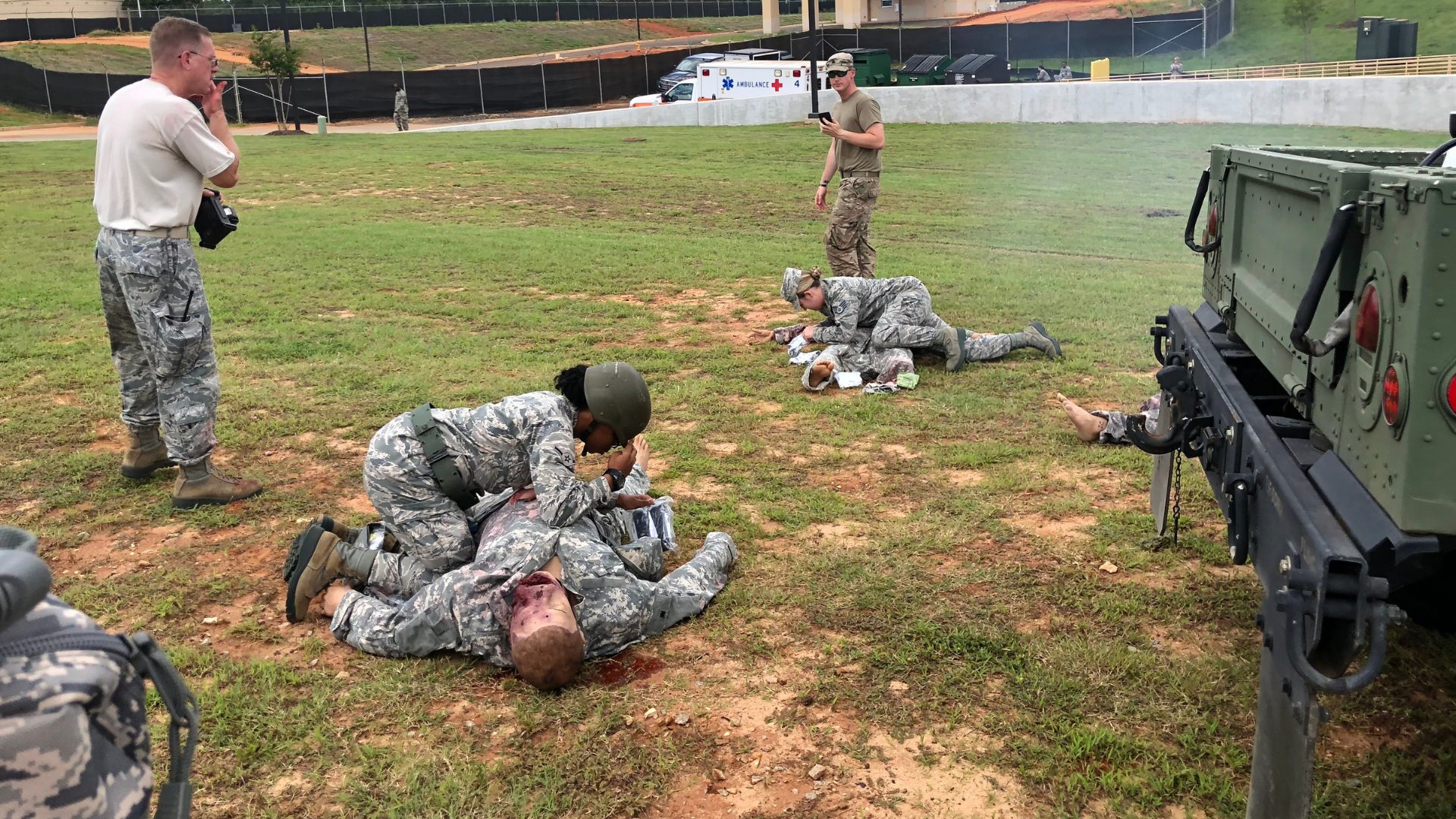
High-fidelity live-action exercises remain valuable, but their extreme cost and complexity severely restrict how often personnel can participate. Planning a single-day event, such as a mass casualty explosion, often takes up to a year of coordination with both military personnel and local community partners. After-action reporting and command-level debriefs required to identify training gaps can take months, delaying the next exercise’s planning cycle by as much as a year. Ultimately, despite all that preparation, only a small fraction of a unit or wing actually gets to participate in the scenario.
Executing the exercise brings its own administrative burdens. The team assigned to run the scenario is often drafted on short notice, some getting as little as a single day to prepare. On the day of the exercise, setting up realistic environments, physical manikins, and moulage can require eight or more hours of morning prep.
This setup process inherently creates a tiered experience:
- The First Group: Receives pristine physical manikins, fresh simulated blood, and peak instructor energy.
- Every Subsequent Group: Experiences degraded setups, worn props, and exhausted staff. This dynamic affects both military units and civilian first responders.
Advanced full-body trauma manikins can cost $100,000+ and incur high ongoing maintenance costs. Add contractor costs, roleplayers, and pyrotechnics, which simulation experts estimate can run upwards of $13,500 per day, and frequent live training becomes unsustainable. As a result, standard instruction often falls back on hours of slides or basic task trainers.
Training for Cognitive Overload and Building Muscle Memory
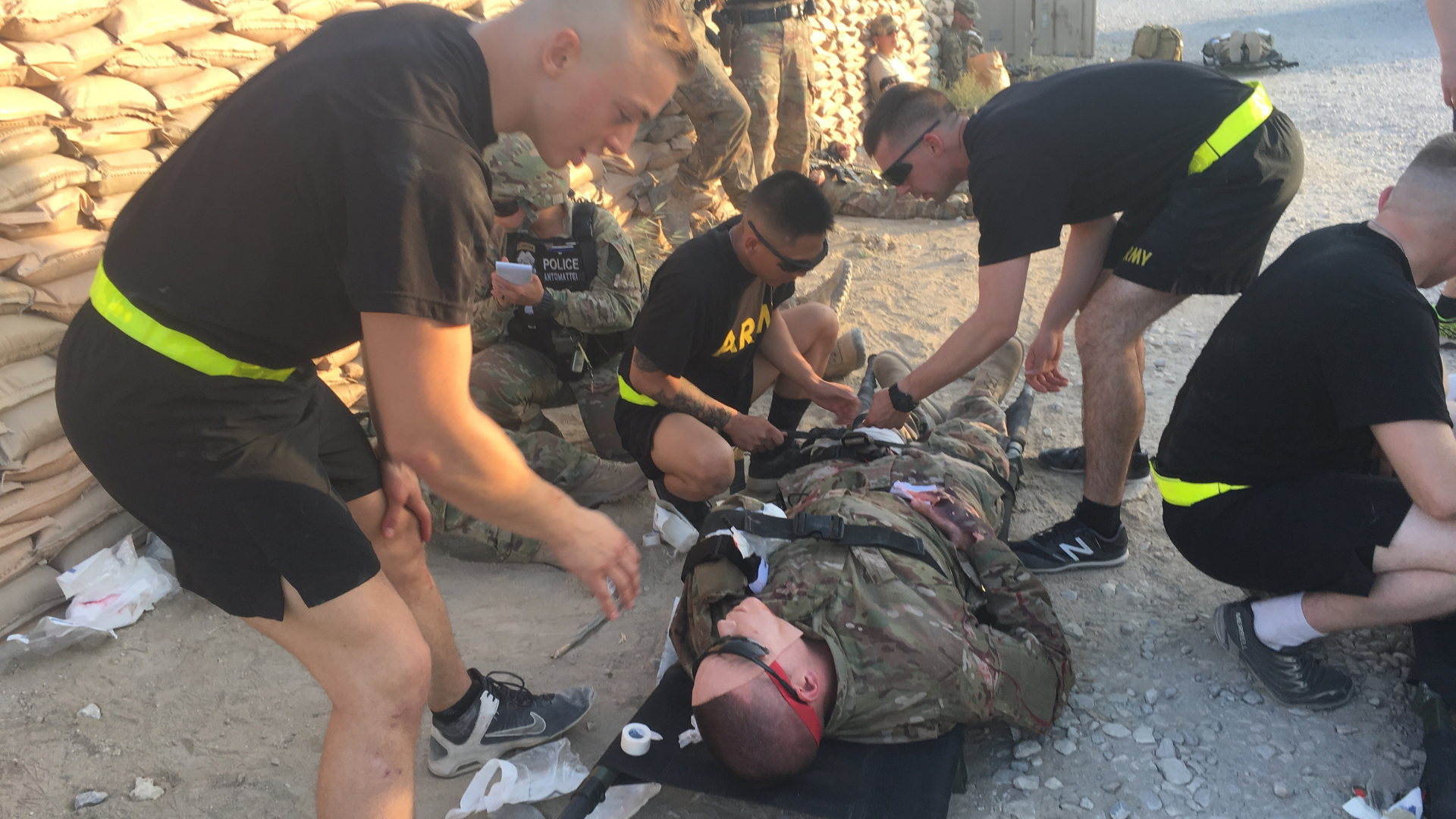
A core objective of high-stress tactical training is conditioning personnel to act despite natural survival instincts through repetitive, standardized practice. Under direct threat, an individual’s immediate reaction may be to freeze or seek cover. Effective tactical medical training conditions personnel to execute immediate life-saving interventions like applying a tourniquet or dragging a casualty to safety despite intense environmental stress.
“The ultimate goal for the upcoming training integration is to leverage this technology to foster consistent muscle memory, ensuring that life-saving responses become automatic even under extreme stress.” — Sean Peck, M.Ed., NRP, CHSE, Clinical Education Manager, SimX
Achieving this requires sensory immersion. VR introduces dynamic visual and auditory stressors that challenge the learner’s cognitive load, including:
- Spatial audio: Directional gunfire and local sound cues.
- Environmental stressors: Overhead drone activity and incoming rounds striking nearby structures.
- Visceral reactions: Realistic casualty vocalizations and authentic emotional responses.
By exposing personnel to these sensory elements in a controlled setting, training accelerates the transition from hesitancy to automatic action. This repetition builds a reliable baseline across entire organizations. Furthermore, because every VR iteration is digitally generated, every single participant from the first group to the last receives the exact same high-fidelity experience.
Bridging Military (TCCC) and Civilian (TECC) Applications
Military and civilian tactical medical responses share many core clinical skills, such as wound packing and hemorrhage control. However, their differing operational environments dictate how those skills are deployed.
- Military Context — Tactical Combat Casualty Care (TCCC): Training focuses heavily on contested environments where personnel operate under active threat. For non-medical personnel, from All Service Members (ASM) up to advanced medical providers, the focus is surviving care under fire with only an Individual First Aid Kit (IFAK). Resources in this environment are very limited, driving strict triage decisions on the scope of care that can be rendered.
- Civilian Context — Tactical Emergency Casualty Care (TECC): Civilian responders typically operate within structured threat zones (such as Hot, Warm, and Cold zones). In active threat scenarios, emergency protocols call for Rescue Task Forces (RTFs) or warm-zone entry teams to enter cleared spaces alongside law enforcement to treat preventable trauma quickly. Unlike combat zones, resources in civilian environments are often plentiful, meaning triage decisions focus primarily on the order in which care is provided.
VR provides a flexible framework that can adapt across both sectors. By adjusting the environment and available resources, military scenarios can be adapted for civilian police, fire, and emergency medical service (EMS) teams without rebuilding the simulation from scratch.
VR as an Operational Layer
Integrating VR into training pipelines does not mean replacing physical manikins or capstone field exercises. Instead, VR functions as an accessible, low-cost means of conducting frequent repetitions long before a major live exercise takes place. Because VR headsets require minimal physical setup time, organizations can deploy high-fidelity simulations in standard rooms without spending hours mixing fake blood or prepping fragile equipment.
As Cheryl Lockhart, Col, USAF (Ret.), Principal Consultant, Military Strategy and Readiness at SimX with 32 years of experience in the Air Force and Army National Guard explains, traditional live-training schedules simply cannot keep up with modern mission demands.
“VR is essential for the military because current operational tempos do not allow for the time or personnel resources required for frequent, high-fidelity live training.”
— Cheryl Lockhart, Col, USAF (Ret.) Principal Consultant, Military Strategy and Readiness, SimX
This low-friction deployment unlocks several key advantages across both military and civilian operations:
- Daily and Weekly Repetitions: Personnel can train frequently without depleting physical resources, burning through consumable supplies, or needing hours of morning prep.
- Standardization Across Teams: For teams deploying together with little prior shared history, VR trains everyone to the same standard and exposes them to identical operational stressors.
- Stress Exposure Before Live Exercises: Personnel build stress resilience and muscle memory beforehand, allowing teams to get far more value out of expensive, full-scale capstone simulations.
- Rapid Readiness for Non-Medics: Non-medical personnel, such as general military service members or civilian law enforcement officers, can regularly practice core tactical combat casualty actions without requiring dedicated medical staff to run the session.
Translating Operational Needs into Scenario Design
Building effective simulation requires a precise balance of emotional realism, environmental stress, and strict curriculum alignment. Whether training military medics, civilian EMS teams, or hospital-based clinicians, immersive VR scenarios must be purpose-built to reinforce automatic, life-saving decision-making.
SimX specializes in translating complex operational standards into high-fidelity VR medical training simulations across the entire spectrum of care, an effort informed by former military officers on staff, including Cheryl Lockhart, Col, USAF (Ret.), a critical care and aeromedical evacuation nurse leader, and Dr. John Dorsch, Col, USAF (Ret.), a Special Operations emergency medicine physician. These design principles are shaping the company’s upcoming All Service Member (ASM) Tier 1 scenario, with additional medical training solutions in development.
Explore How SimX Designs Scenarios for High-Stakes Environments
Interested in discovering how scenario-based VR simulation can elevate your team’s readiness for extreme environments? Watch our webinar on, “Designing for Chaos: Building Repeatable High-Stress Scenarios for Medical Readiness,” to learn more.