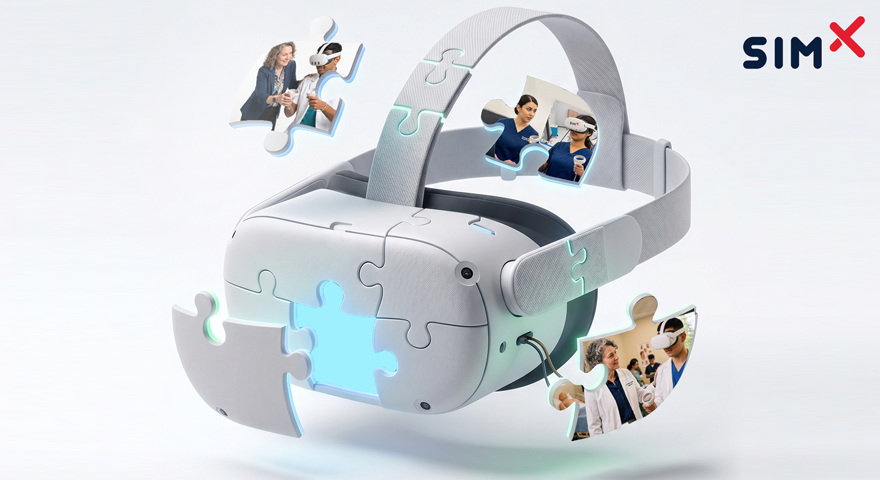
Healthcare simulation has become a cornerstone of modern clinical education. It allows providers to practice high-stakes decision-making and teamwork in a safe, controlled environment. However, traditional simulation—relying on high-fidelity manikins and dedicated simulation centers—is often difficult to implement. For rural and remote programs, the cost of specialized staff and infrastructure can further create significant training disparities.
Virtual reality (VR) platforms like SimX are transforming this landscape. By leveraging wireless headsets and portable hardware, facilitators can now deploy immersive clinical training in classrooms, rural clinics, or conference rooms. Developed by clinicians for clinicians, SimX focuses on complex, lifelike patient encounters that build critical thinking without the need for a permanent simulation center.
The Shift to Immersive Virtual Reality (IVR)
Unlike traditional modalities, IVR replaces the physical environment with a fully digital one, allowing users to feel psychologically located in the simulated environment as if it were real. This presence enables repeatable clinical scenarios across diverse patient representations, environments, and pathologies that are often difficult to simulate with manikins or standardized patients.
While IVR offers greater flexibility and access, integrating it into routine practice is a challenge. Most facilitation best practices were developed for environments that differ substantially from IVR. To successfully integrate this modality, we must first understand the new demands it places on the people running the simulations.
The Research: Mapping the Facilitator’s Workflow
A study by Nora Carr, Dr. Jen Polson, and Dr. Karthik Sarma, titled “A Mixed-Methods Analysis of Facilitator Activities in Fully Immersive Virtual Reality (VR) Medical Simulation,” set out to understand these demands and map these behaviors. The goal was to identify the motivations and pain points of those running simulations to determine how technology could better support them.
Study Methodology
The researchers used a contextual inquiry framework to observe facilitators in their natural training environments. The study included:
- 20 Facilitators: A mix of faculty, technicians, and peer learners across five institutions.
- 42 Simulation Sessions: A total of 42 individual virtual patient encounters averaging 18 minutes in length.
- Four-Stage Data Collection: The team used pre-simulation interviews, live observation with behavioral coding, post-session interviews, and surveys to capture a complete picture of the facilitator’s experience.
Main Findings: The 1/3 vs. 2/3 Burden
The research revealed that facilitators are often overwhelmed by the software’s operational demands. Quantitative analysis showed:
- One-third of facilitator time is spent on observation and cognitive processing.
- Two-thirds of facilitator time is actively performing scenario facilitation tasks.
These tasks include running the software, providing technical support, giving medical instruction, and managing immersion-breaking events. As one faculty facilitator noted, “I can’t be the teacher keeping track of things and looking at what they’re doing at the same time. It just seems like it’s too much.”
The Dialogue Bottleneck
Managing character dialogue was identified as the most time-consuming task, accounting for over 40% of the total task time. Interestingly, the study found that 50% of dialogue lines served as “cues”—strategic hints that guided the learner through the clinical pathway. This means facilitators spend a massive amount of time hunting for buttons to give hints rather than focusing on student evaluation.
Scaling Training Without Faculty Burnout
The insights from this study directly informed the development of SimX’s AI Assistant. By understanding that dialogue and scenario operations are the primary sources of “facilitator fatigue,” SimX built a tool to automate these tasks while keeping the educator in the loop.
SimX’s AI Assistant helps institutions scale their programs without needing to hire more staff. By automating character management, dialogue, and scenario flow, educators can shift their focus back to coaching and evaluation.
- Automated Cues: Since research showed half of dialogue is used for guiding learners, the AI Assistant handles these interactions automatically based on expert-authored logic.
- Team-Based Realism: Multiple learners can engage with patients and bystanders simultaneously, with the AI coordinating responses across all characters.
- Bridging the Resource Gap: In rural or low-resource settings where the facilitator-to-learner ratio is high, the AI Assistant acts as a co-pilot, ensuring the simulation runs smoothly even with limited staff.
“For facilitators, [AI Assistant] makes moderating easier by allowing more time to focus on leading the learning experience and observing progress within the scenario. For users, it creates a more realistic experience by allowing them to interact directly with the patient and other people in the virtual environment,” said Kris Bickell, Senior Simulation Learning Consultant at Yale Center for Healthcare Simulation.
Clinical Accuracy You Can Trust
Unlike open-ended generative AI that might “hallucinate” or improvise, the SimX AI Assistant is built on a clinically grounded framework.
- Strict Scenario Adherence: The AI remains bounded by the expert-authored educational design and never deviates from the validated clinical pathway.
- Educator Authority: Faculty can observe, intervene, or override the AI at any time. It is a tool designed to empower the educator, not replace them.
The Future of High-Tech, High-Touch Training
By removing the technical friction identified in the Carr, Polson, and Sarma study, SimX allows healthcare programs to focus on what matters most: developing clinical judgment, teamwork, and empathy. Whether you are training in a major academic center or a remote clinic, research-driven AI is making it possible to deliver consistent, high-fidelity education to every learner.