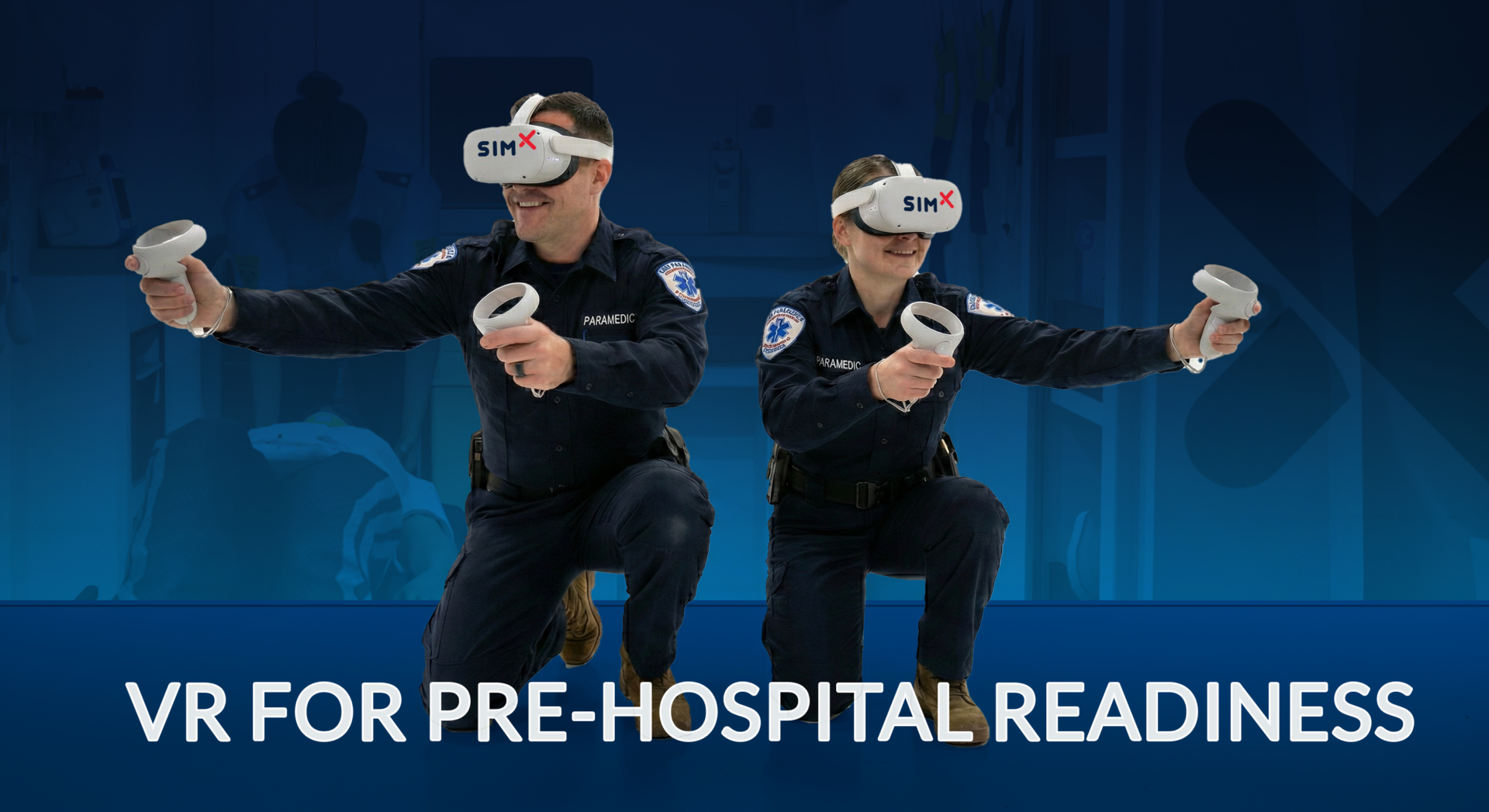
In emergency medicine, preparation isn’t optional, it’s everything.
EMS teams are expected to perform flawlessly in rare, high-risk moments: sudden cardiac arrests, complex trauma scenes, airway emergencies where every decision carries weight. Yet these are the very situations that are hardest to practice regularly.
Traditional manikin-based simulation remains an essential tool, but it comes with real limitations. It requires significant staffing, specialized equipment, dedicated space, and complex logistics. Recreating realistic field environments is difficult. Repeating rare scenarios frequently is costly. And coordinating full teams for high-acuity training can strain even the best programs.
At SimX, our clinical, simulation, and education experts recognized the responsibility to ask a critical question:
Can immersive virtual reality deliver the realism, performance outcomes, and usability EMS teams need, without the traditional resource burden?
To answer it, we conducted an IRB-approved observational study using the SimX immersive VR platform, evaluating real learner performance in a high-stakes, team-based cardiac arrest simulation.
What we found was both validating and transformative.
Stepping Inside a High-Risk Emergency, Virtually
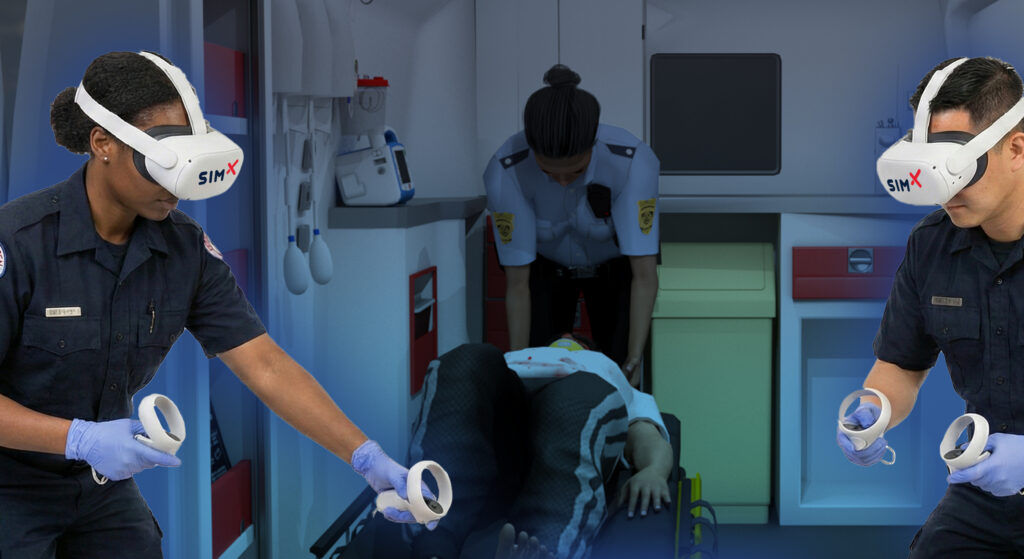
Rather than observing from the sidelines, EMS learners were placed directly inside a realistic emergency scene using immersive VR.
Participants ranged from EMT trainees to paramedics, all working together in a coordinated response to a submerged patient progressing into cardiac arrest. The scenario required rapid assessment, communication, CPR, ventilation, and resuscitation — the same cognitive and procedural demands faced in the field.
Learners completed:
- Orientation and practice within VR
- A full immersive team-based cardiac arrest simulation
- Post-training evaluations measuring performance, realism, usability, and comfort
Meanwhile, SimX’s platform automatically tracked completion of critical clinical actions while facilitators monitored the scenario in real time.
This wasn’t theoretical learning. It was hands-on emergency response — inside VR.
Real Performance in a Virtual Environment
The results were clear: EMS teams didn’t just engage with VR. They performed.
Across participants, learners completed an average of 71.7% of critical clinical actions required for effective cardiac arrest management.
Core lifesaving interventions were consistently executed:
- Initiation of CPR
- Pulse checks
- Ventilation
- Vital sign assessments
- Clear team communication and handoff
Lower completion rates appeared primarily in advanced skills such as definitive airway placement or IV access — largely reflecting scope-of-practice differences among learners rather than limitations of VR itself.
In fact, the platform helped identify precisely where additional education could be focused, offering objective insights that traditional simulation often struggles to capture.
Immersive VR supported real clinical decision-making, real teamwork, and real performance.
“It Felt Real” – And That’s Where Learning Sticks
One of the most powerful findings wasn’t just what learners did, but how they felt doing it.
Participants rated the VR environment highly for realism and presence:
- Realistic medical tools and field environments
- Strong sense of immersion
- Natural interaction with patients and teammates
- Clear visual and auditory cues
Learners consistently reported feeling fully engaged, focused, and emotionally invested in the scenario.
This level of immersion matters. When simulation feels authentic, learners think and behave the way they will in real emergencies, strengthening knowledge retention and skill transfer.
Technology EMS Teams Actually Want to Use
Innovation only works when it’s usable.
The study showed exceptional adoption readiness:
- System Usability Score: 76 (well above industry benchmarks)
- Net Promoter Score: 69.6 (an excellent rating for training technology)
Learners found the platform intuitive, valuable, and something they would recommend to peers.
Just as important, concerns about motion sickness were minimal. Participants reported little to no discomfort, directly addressing one of the most common hesitations around immersive VR in education.
Why This Matters for EMS Training Leaders
This study validates immersive VR as a powerful complement to traditional simulation, not a replacement.
With SimX, EMS programs can:
- Train full teams without logistical bottlenecks
- Repeat rare, high-risk scenarios frequently
- Simulate realistic field environments anytime
- Collect objective performance data automatically
- Scale high-fidelity training without scaling cost and staffing
Instead of being limited by resources, educators can focus on readiness.
Instead of saving rare scenarios for special occasions, learners can experience them routinely.
A New Standard for High-Stakes EMS Preparation
The findings from this IRB-approved study demonstrate that immersive VR:
- Delivers strong clinical performance
- Creates realistic, high-pressure learning environments
- Is highly usable and well accepted by learners
- Minimizes physical discomfort
- Expands access to high-fidelity team-based training
For EMS educators, training officers, and chiefs, this represents a meaningful shift in what’s possible.
Immersive VR doesn’t replace hands-on simulation.
It expands it.
Strengthens it.
And makes elite-level training accessible at scale.
Preparing for the Moments That Matter Most
Emergencies don’t happen in classrooms. They happen in unpredictable environments under intense pressure where teamwork and clinical execution must be flawless.
This research confirms what many in EMS education have hoped: immersive VR can place teams inside those moments safely, repeatedly, and effectively.
Not someday.
Right now.
At SimX, we’re proud to be leading the future of healthcare simulation with the world’s largest library of clinician-authored VR scenarios, designed to complement traditional simulation and elevate team readiness across emergency care.
Because when seconds matter, preparation should never be limited by resources.
Book a VR Simulation Walkthrough for Your EMS Program